Introduction
Modern organizations generate more data than ever before. Employee productivity, project completion, customer satisfaction, response times, and business performance are all tracked through dashboards, analytics, and key performance indicators (KPIs). While these metrics help leaders make informed decisions, they can also create workplaces where success is measured more by numbers than by creativity, collaboration, or meaningful impact.
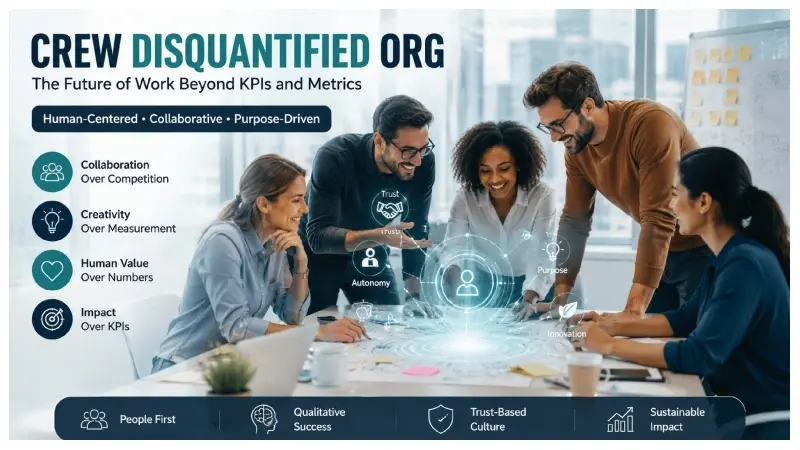
This shift has led to growing discussions around Crew Disquantified Org, a concept that encourages organizations to balance quantitative data with human-centered evaluation. Instead of judging employees solely by measurable output, this approach recognizes qualities such as innovation, teamwork, leadership, adaptability, and problem-solving—factors that often determine long-term success but cannot always be expressed through statistics.
As artificial intelligence automates repetitive tasks and remote work becomes the norm, businesses are rethinking how they evaluate performance. They are beginning to realize that while data is valuable, it cannot fully capture the contributions that drive innovation, build strong teams, and create exceptional customer experiences.
This guide explains what Crew Disquantified Org means, how it works, why it is gaining attention, and how organizations can combine data-driven decision-making with a people-first culture.
What Is Crew Disquantified Org?
Crew Disquantified Org is an emerging organizational philosophy that promotes evaluating teams through a combination of measurable results and human-centered factors rather than relying exclusively on numerical performance metrics.
The concept can be understood by breaking it into three parts:
- Crew refers to collaborative teams working toward shared objectives.
- Disquantified represents reducing excessive dependence on numbers without eliminating accountability.
- Org refers to an organization that values flexibility, trust, continuous learning, and innovation.
Unlike traditional companies that focus heavily on KPIs, sales targets, productivity reports, or attendance records, Crew Disquantified Org recognizes that many valuable workplace contributions cannot be measured through numbers alone.
These include:
- Creative thinking
- Leadership
- Collaboration
- Emotional intelligence
- Knowledge sharing
- Strategic decision-making
- Adaptability
- Customer relationships
Instead of asking only:
“How many tasks were completed?”
Organizations also ask:
- Did the project solve the customer’s problem?
- Did the team introduce an innovative solution?
- Did employees collaborate effectively?
- Did the work create lasting value?
This broader perspective provides a more accurate understanding of employee performance and organizational success.
Understanding the Meaning of “Disquantified”
The word Disquantified does not mean removing data from decision-making.
Instead, it suggests reducing an unhealthy dependence on numbers when evaluating people.
Businesses still require measurable information for budgeting, forecasting, financial planning, and operational efficiency. However, numbers alone rarely tell the complete story.
Consider these examples.
A software engineer spends three weeks developing a cybersecurity feature that prevents future attacks. Their productivity dashboard shows fewer completed tasks than colleagues who fixed minor bugs every day. Although the engineer completed fewer tickets, the long-term value they created is significantly greater.
Similarly, a customer support specialist may spend extra time helping customers solve complex issues. Traditional metrics might show fewer daily interactions, but customer satisfaction and loyalty increase because problems are solved correctly.
Crew Disquantified Org encourages leaders to recognize these invisible contributions instead of relying exclusively on performance dashboards.
Why Traditional KPIs Are No Longer Enough
For decades, organizations have depended on Key Performance Indicators (KPIs) to evaluate success.
Common KPIs include:
- Revenue generated
- Sales completed
- Tasks finished
- Attendance percentage
- Customer response time
- Production output
- Error rates
- Delivery speed
These measurements remain valuable because they provide objective information.
However, problems arise when organizations treat KPIs as the only measure of success.
Numbers Cannot Measure Creativity
Innovation rarely follows a predictable path.
Employees often test multiple ideas before discovering an effective solution.
When organizations reward only measurable output, employees become reluctant to experiment because unsuccessful attempts may reduce performance scores.
Over time, creativity declines, and businesses become less innovative.
Metrics Can Encourage Unhealthy Behavior
Employees naturally optimize whatever is measured.
For example:
If customer service representatives are rewarded only for closing tickets quickly, they may rush conversations rather than solving problems completely.
If software developers are judged solely by the number of lines of code they write, they may produce unnecessary code instead of efficient solutions.
These behaviors improve statistics but often reduce overall quality.
Excessive Monitoring Reduces Trust
Many organizations now monitor:
- Keyboard activity
- Screen time
- Login duration
- Mouse movement
- Online status
- Application usage
Although intended to improve productivity, excessive surveillance often creates anxiety rather than better performance.
Employees begin focusing on appearing busy instead of creating meaningful results.
Crew Disquantified Org promotes trust-based accountability rather than continuous observation.
Human Contributions Often Remain Invisible
Many important workplace activities cannot be measured using dashboards.
Examples include:
- Mentoring new employees
- Sharing knowledge
- Resolving team conflicts
- Encouraging innovation
- Supporting colleagues
- Building company culture
- Strengthening customer relationships
These contributions improve organizational performance over time but rarely appear in traditional reports.
A human-centered evaluation system ensures these efforts receive appropriate recognition.
Core Principles of Crew Disquantified Org
Although organizations may implement this philosophy differently, most successful human-centered workplaces follow several common principles.
1. People Before Metrics
Performance data provides useful insights, but employees should never become just numbers.
Organizations recognize individual strengths, creativity, and unique perspectives alongside measurable achievements.
Rather than replacing human judgment, data supports better decision-making.
2. Collaboration Over Competition
Traditional performance systems often encourage employees to compete against one another.
Ranking systems, scorecards, and individual bonuses may improve short-term productivity while reducing teamwork.
Crew Disquantified Org shifts the focus toward collective success.
Instead of asking:
“Who performed best?”
Leaders ask:
“How did the team solve the challenge together?”
This encourages knowledge sharing, stronger communication, and greater trust.
3. Trust Creates Better Performance
Micromanagement limits creativity.
Employees perform better when they receive greater autonomy and responsibility.
Trust allows team members to:
- Make decisions independently
- Take ownership of projects
- Learn from mistakes
- Develop leadership skills
- Solve problems creatively
Rather than monitoring every activity, leaders provide guidance while allowing employees to work independently.
4. Continuous Learning Over Perfect Performance
Mistakes become opportunities for growth rather than reasons for punishment.
Organizations encourage employees to:
- Learn new skills
- Experiment with ideas
- Reflect on failures
- Share knowledge
- Improve continuously
This learning culture strengthens innovation and prepares organizations for future challenges.
5. Long-Term Value Matters More Than Short-Term Numbers
Immediate productivity remains important.
However, sustainable success depends on factors that develop over time.
These include:
- Customer loyalty
- Employee engagement
- Innovation culture
- Brand reputation
- Leadership development
- Cross-functional collaboration
Crew Disquantified Org encourages organizations to evaluate both short-term achievements and long-term organizational health.
Why Crew Disquantified Org Is Becoming More Relevant
Several workplace trends have increased interest in human-centered organizational models.
Artificial Intelligence Is Changing Work
AI now performs many repetitive tasks faster than humans.
As automation expands, organizations increasingly value uniquely human abilities such as:
- Critical thinking
- Creativity
- Emotional intelligence
- Ethical decision-making
- Leadership
- Strategic planning
Businesses that recognize these strengths gain competitive advantages that technology alone cannot provide.
Remote Work Requires Greater Trust
Distributed teams cannot rely on physical supervision.
Managers increasingly evaluate employees based on communication quality, collaboration, reliability, and project outcomes rather than office attendance.
Crew Disquantified Org naturally aligns with this shift by emphasizing trust, accountability, and meaningful contribution instead of constant monitoring.
Employees Want More Purpose
Today’s professionals increasingly seek workplaces that offer:
- Flexible schedules
- Meaningful work
- Professional development
- Greater autonomy
- Healthy work-life balance
- Opportunities to innovate
Organizations embracing these priorities often experience higher employee satisfaction, stronger retention, and better long-term performance.
How Crew Disquantified Org Works in Practice
Understanding the philosophy behind Crew Disquantified Org is only the first step. Its real value becomes clear when organizations apply these principles to everyday operations. Rather than removing structure or accountability, this model redesigns how teams collaborate, make decisions, and evaluate success.
Organizations that adopt this approach still define goals, monitor progress, and measure business outcomes. The difference is that performance reviews no longer depend solely on numerical metrics. Leaders also consider creativity, collaboration, customer impact, continuous learning, and long-term value creation.
Instead of asking employees to maximize numbers alone, organizations encourage them to solve problems, experiment with new ideas, and contribute to shared success.
Real-World Applications Across Industries
Although Crew Disquantified Org is an emerging philosophy, many organizations already practice similar human-centered management principles.
1. Technology Companies
Technology companies depend on innovation. Developers, designers, and engineers often spend weeks researching, testing, and improving solutions before delivering a final product.
Traditional performance systems usually measure:
- Tasks completed
- Sprint velocity
- Lines of code
- Bug fixes
- Development hours
While these metrics provide useful information, they rarely show whether the product actually improves customer experience.
Organizations following Crew Disquantified Org also evaluate:
- Software quality
- Product innovation
- User satisfaction
- Team collaboration
- Knowledge sharing
- Long-term maintainability
This encourages employees to build better products instead of simply producing more output.
2. Creative Agencies
Creative work cannot always be measured through numbers.
Graphic designers, writers, marketers, photographers, and video editors often require time to research, brainstorm, and refine ideas before producing outstanding work.
Instead of measuring only:
- Billable hours
- Projects completed
- Daily productivity
Creative organizations also consider:
- Originality
- Campaign performance
- Brand impact
- Client satisfaction
- Creative problem-solving
This environment allows creativity to flourish without sacrificing accountability.
3. Healthcare Organizations
Healthcare demonstrates why numbers alone cannot define success.
Doctors and nurses cannot be judged only by:
- Number of patients treated
- Appointment speed
- Administrative efficiency
Quality healthcare also depends on:
- Compassion
- Communication
- Accurate diagnosis
- Patient trust
- Team coordination
Hospitals increasingly recognize that collaboration and empathy directly improve patient outcomes.
4. Educational Institutions
Education is gradually shifting beyond standardized testing.
Traditional systems often emphasize:
- Test scores
- Attendance
- Graduation rates
Modern educational models increasingly value:
- Critical thinking
- Communication skills
- Creativity
- Teamwork
- Practical problem-solving
Teachers also benefit from evaluations based on classroom engagement, student development, and innovative teaching methods instead of test results alone.
5. Remote and Hybrid Teams
Remote work has transformed workplace management.
Managers can no longer rely on physical supervision to measure productivity.
Successful remote organizations focus on:
- Project completion
- Communication quality
- Reliability
- Initiative
- Customer satisfaction
- Team participation
This trust-based approach improves morale while maintaining strong business performance.
Traditional Organization vs. Crew Disquantified Org
| Traditional Organization | Crew Disquantified Org |
|---|---|
| Focuses heavily on KPIs | Balances data with human insight |
| Fixed job roles | Flexible responsibilities |
| Hierarchical leadership | Collaborative team structure |
| Constant employee monitoring | Trust-based accountability |
| Individual competition | Shared team success |
| Short-term productivity | Long-term organizational value |
| Quantitative evaluation | Quantitative + qualitative evaluation |
| Micromanagement | Employee autonomy |
| Output-focused | Impact-focused |
This comparison shows that Crew Disquantified Org does not reject business metrics—it simply broadens the definition of success.
Major Benefits of Crew Disquantified Org
Organizations adopting a balanced evaluation system often experience significant long-term advantages.
Greater Innovation
Innovation requires experimentation.
Employees who are free to explore new ideas without fear of damaging performance scores become more willing to solve complex problems creatively.
Many breakthrough products have emerged because organizations encouraged experimentation rather than rewarding only immediate productivity.
Higher Employee Engagement
Employees perform better when they feel trusted and respected.
Organizations that value ideas as much as measurable output often experience:
- Greater motivation
- Stronger commitment
- Better communication
- Increased participation
- Higher job satisfaction
Engaged employees frequently contribute beyond their official responsibilities.
Better Collaboration
Traditional ranking systems sometimes create unnecessary competition.
Crew Disquantified Org encourages employees to:
- Share knowledge
- Mentor colleagues
- Solve problems together
- Support cross-functional projects
- Build stronger relationships
This collaborative culture improves both productivity and workplace satisfaction.
Improved Customer Experience
Customers rarely judge companies based on internal performance metrics.
Instead, they care about:
- Product quality
- Fast problem resolution
- Honest communication
- Reliable service
- Personalized support
Organizations that prioritize customer outcomes often build stronger long-term loyalty.
Increased Employee Retention
Modern professionals increasingly seek workplaces that provide:
- Flexibility
- Purpose
- Professional growth
- Autonomy
- Healthy work environments
Companies embracing human-centered leadership often experience lower turnover and attract highly skilled talent.
Challenges of Implementing Crew Disquantified Org
Despite its advantages, adopting this philosophy requires careful planning.
Balancing Freedom with Accountability
Too much flexibility without clear expectations can create confusion.
Successful organizations establish:
- Shared objectives
- Defined responsibilities
- Transparent communication
- Regular feedback
Freedom works best when supported by accountability.
Measuring Qualitative Contributions
Creativity, leadership, and collaboration cannot always be converted into numbers.
Organizations therefore combine several evaluation methods, including:
- Peer reviews
- Customer feedback
- Manager observations
- Project outcomes
- Self-assessments
This creates a more balanced understanding of employee performance.
Cultural Resistance
Employees and managers accustomed to KPI-driven systems may initially resist change.
Leaders should clearly explain:
- Why the organization is changing
- How success will be evaluated
- What benefits employees can expect
Gradual implementation usually produces better results than sudden organizational transformation.
Maintaining Business Performance
Some executives worry that reducing emphasis on metrics will decrease productivity.
However, Crew Disquantified Org does not eliminate measurement.
Financial performance, customer satisfaction, and operational efficiency remain important.
The difference is that leaders use numbers alongside professional judgment instead of allowing dashboards to become the only decision-making tool.
Practical Steps to Implement Crew Disquantified Org
Organizations interested in adopting this philosophy can begin with several practical actions.
Build a Trust-Based Culture
Trust forms the foundation of every successful human-centered workplace.
Leaders should:
- Delegate responsibility
- Reduce unnecessary micromanagement
- Encourage independent decision-making
- Support employee ownership
Redesign Performance Reviews
Traditional annual reviews often focus heavily on numerical scores.
A balanced evaluation also considers:
- Innovation
- Collaboration
- Leadership
- Learning
- Customer impact
- Problem-solving
This creates a more complete picture of employee performance.
Encourage Cross-Functional Teams
Departments working together often discover better solutions than isolated teams.
Cross-functional collaboration introduces:
- Fresh perspectives
- Faster innovation
- Better communication
- Stronger organizational learning
Reward Learning and Experimentation
Organizations should recognize employees who:
- Learn new skills
- Test new ideas
- Share knowledge
- Improve existing processes
- Provide constructive feedback
Learning contributes to long-term organizational success.
Use Data as a Guide, Not a Judge
Analytics remain valuable.
However, leaders should use data to support conversations rather than replace human judgment.
Balanced decision-making combines measurable evidence with experience, observation, and context.
Signs Your Organization May Need This Approach
Many organizations unknowingly rely too heavily on performance metrics.
Common warning signs include:
- Employees focus only on hitting KPIs.
- Innovation has slowed significantly.
- Teams compete instead of collaborating.
- Staff members fear making mistakes.
- Employee burnout continues to rise.
- High-performing employees leave frequently.
- Customer satisfaction declines despite strong productivity reports.
If several of these problems exist, adopting a more human-centered evaluation system may improve both employee well-being and long-term business performance.
The Future of Crew Disquantified Org
The future of work is unlikely to be defined by numbers alone. Organizations will continue using analytics, dashboards, and artificial intelligence, but these tools will increasingly support human decision-making rather than replace it.
As businesses become more digital, qualities such as creativity, emotional intelligence, adaptability, and ethical leadership will become stronger competitive advantages. Companies that recognize these strengths are more likely to build resilient teams and maintain long-term growth.
Crew Disquantified Org reflects this shift by encouraging leaders to evaluate both measurable performance and the human qualities that drive innovation.
Instead of asking only “How much work was completed?”, future organizations will also ask:
- Did the work create lasting value?
- Did it strengthen customer relationships?
- Did it improve teamwork?
- Did employees learn and grow?
- Did it encourage innovation?
These questions help organizations look beyond short-term numbers and focus on sustainable success.
The Role of Artificial Intelligence in Human-CCentered Organizations
Artificial intelligence is transforming nearly every industry.
Routine tasks such as data entry, scheduling, reporting, and basic customer support are increasingly handled by AI-powered systems.
As automation expands, human skills become even more valuable.
Organizations adopting Crew Disquantified Org recognize that AI performs best when it supports employees rather than replaces them.
Future workplaces will increasingly value:
- Strategic thinking
- Ethical decision-making
- Creative problem-solving
- Emotional intelligence
- Leadership
- Adaptability
- Cross-functional collaboration
Rather than competing with technology, employees will focus on areas where human judgment provides the greatest value.
Why Business Leaders Are Paying Attention
Many executives now recognize that high-performing organizations are built through trust, collaboration, and innovation—not just productivity dashboards.
Several workplace trends support this shift:
Employee Expectations Are Changing
Modern professionals increasingly seek:
- Flexible work arrangements
- Career development
- Purpose-driven organizations
- Respect and autonomy
- Healthy work-life balance
Organizations that meet these expectations often experience stronger retention and higher engagement.
Innovation Has Become Essential
Markets evolve quickly.
Businesses that cannot adapt risk falling behind competitors.
Innovation depends on employees feeling comfortable sharing ideas, experimenting with solutions, and learning from failure.
A culture driven entirely by performance metrics often discourages these behaviors.
Collaboration Drives Better Results
Complex business problems rarely belong to one department.
Successful organizations encourage collaboration between:
- Marketing
- Engineering
- Customer support
- Finance
- Product development
- Operations
Crew Disquantified Org supports this collaborative mindset by rewarding shared success rather than individual competition.
Common Misconceptions About Crew Disquantified Org
Although the concept is gaining attention, several misunderstandings still exist.
Myth 1: It Eliminates KPIs
False.
The philosophy does not reject KPIs.
Instead, it treats performance metrics as one part of a broader evaluation system.
Myth 2: Employees Can Work Without Accountability
False.
Organizations still define goals, monitor progress, and evaluate results.
The difference is that leaders also consider creativity, teamwork, and long-term impact.
Myth 3: It Only Works for Creative Companies
False.
While creative industries naturally benefit from this approach, organizations in healthcare, education, consulting, technology, manufacturing, and professional services can also apply many of its principles.
Myth 4: It Reduces Productivity
Research on employee engagement consistently suggests that trusted and empowered employees often perform better over time.
Organizations focusing only on short-term productivity sometimes overlook the factors that create sustainable business growth.
Best Practices for Organizations
Businesses interested in adopting Crew Disquantified Org should consider several best practices.
Balance Data With Human Judgment
Numbers provide valuable insights, but they should support decision-making rather than replace professional experience.
Build a Culture of Trust
Employees perform best when they feel respected and empowered.
Trust encourages initiative, ownership, and innovation.
Encourage Continuous Learning
Organizations should reward curiosity, experimentation, and skill development alongside measurable achievements.
Learning strengthens long-term competitiveness.
Celebrate Team Success
Recognition should extend beyond individual performance.
Celebrating collaborative achievements strengthens relationships across departments.
Review Performance Holistically
Performance evaluations should include:
- Business outcomes
- Customer impact
- Leadership
- Collaboration
- Creativity
- Learning
- Innovation
This balanced approach creates fairer and more meaningful assessments.
Frequently Asked Questions
What does Crew Disquantified Org mean?
Crew Disquantified Org is a human-centered organizational philosophy that balances measurable business performance with qualitative factors such as collaboration, creativity, trust, leadership, and long-term value.
Does it completely replace KPIs?
No.
KPIs remain useful for measuring business performance.
However, organizations also evaluate contributions that cannot easily be expressed through numbers.
Which industries benefit the most?
The philosophy can benefit many industries, including:
- Technology
- Healthcare
- Education
- Consulting
- Marketing
- Creative agencies
- Startups
- Research organizations
- Remote-first businesses
Is this approach suitable for small businesses?
Yes.
Small organizations often adapt more quickly because communication is simpler and decision-making is less bureaucratic.
How does it support remote work?
Remote teams depend heavily on trust, communication, and collaboration.
Crew Disquantified Org encourages leaders to evaluate project outcomes and teamwork rather than monitoring every employee activity.
Can AI replace this philosophy?
No.
Artificial intelligence improves efficiency but cannot fully replace human creativity, empathy, ethical judgment, or leadership.
Crew Disquantified Org complements AI by emphasizing the uniquely human strengths that technology cannot replicate.
Key Takeaways
Before adopting this philosophy, organizations should remember:
- Numbers remain valuable but should not define every contribution.
- Creativity and collaboration drive long-term innovation.
- Employee trust improves engagement and performance.
- Customer impact matters more than internal scorecards.
- Continuous learning strengthens organizational resilience.
- AI works best when supporting human decision-making.
- Balanced evaluation creates healthier workplaces.
Conclusion
Crew Disquantified Org represents a meaningful evolution in organizational thinking. Rather than measuring success exclusively through dashboards, productivity reports, or KPIs, it encourages leaders to recognize the broader qualities that help teams thrive.
The philosophy does not reject data. Instead, it places data within a larger framework that values creativity, collaboration, adaptability, leadership, emotional intelligence, and meaningful outcomes.
As organizations continue adapting to artificial intelligence, remote work, and rapidly changing business environments, balancing measurable performance with human insight will become increasingly important.
Businesses that embrace this balanced approach are better positioned to build stronger cultures, inspire innovation, retain talented employees, and deliver exceptional value to customers.
Ultimately, Crew Disquantified Org reminds us that while numbers help measure progress, people create progress. Organizations that understand this distinction are more likely to achieve sustainable success in the future.